AI Is Everywhere Today, But Who Is It Actually For?
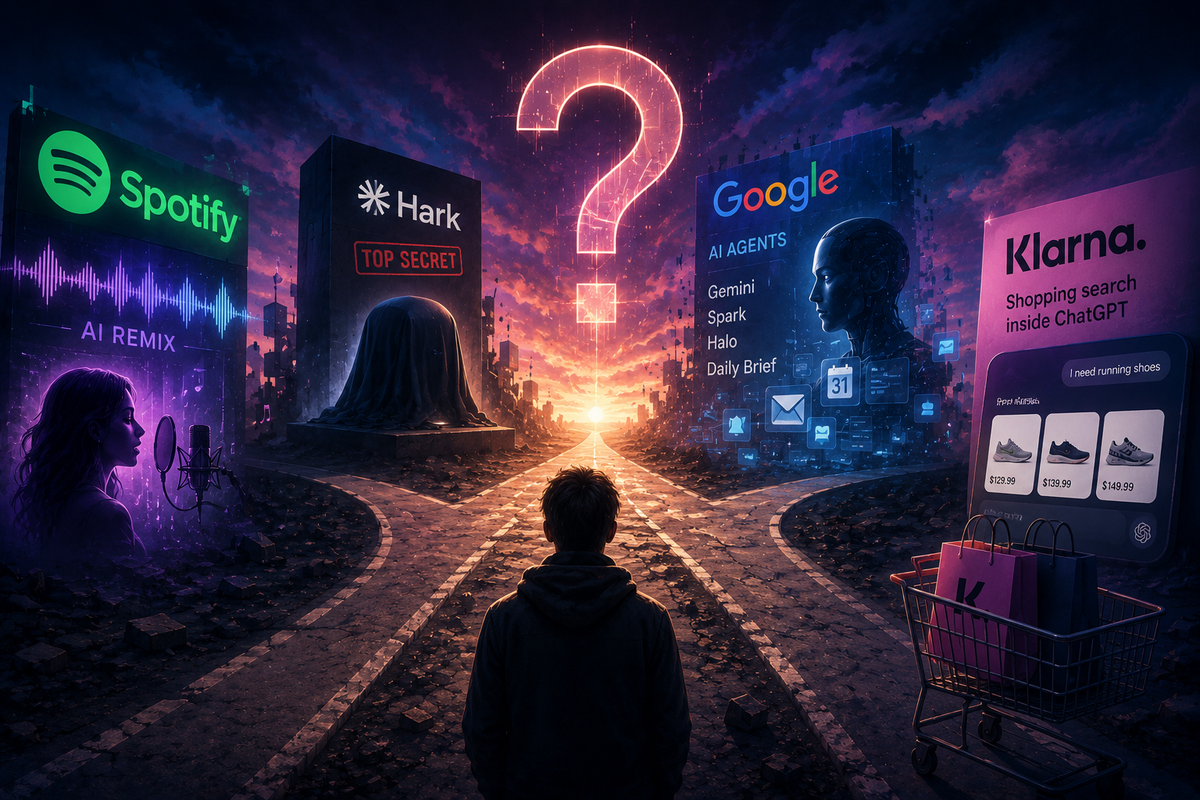
Spotify is letting fans remix Taylor Swift with AI, Google wants agents running your life behind a paywall, and a startup just raised $700M on vibes alone. Meanwhile, the plumbing underneath all of it is getting a serious upgrade.
1. Spotify and Universal Music Cut a Deal for AI-Powered Covers and Remixes
Spotify dropped a bomb at its Investor Day on Thursday: a licensing agreement with Universal Music Group that will let Premium subscribers create AI-generated covers and remixes of songs from participating UMG artists. The tool will launch as a paid add-on (pricing TBD), with artists receiving a revenue share on top of their existing royalties. UMG's roster includes Taylor Swift, Drake, Billie Eilish, and Ariana Grande. Spotify stock jumped roughly 15% on the news.
The broader Investor Day painted the picture of a company that no longer sees itself as a music streaming service. Spotify now has 761 million monthly active users and nearly 300 million subscribers. Management laid out 2030 targets: mid-teens revenue CAGR, 35-40% gross margin, operating margin above 20%, and a moonshot goal of 1 billion subscribers. They also announced Reserved by Spotify, a ticketing feature with Live Nation giving superfans early concert access.
My take: This is Spotify going directly at Suno and Udio, except with actual licensing. That matters. The consent/credit/compensation framework they're building is the part to watch, not the AI remixes themselves. If Spotify can prove there's a monetization model that keeps labels and artists happy while letting fans create, it becomes a template for the entire music industry. The risk is that the "paid add-on for Premium" framing prices out the casual users who would actually make this go viral. And the per-stream rate debate for independent artists doesn't go away just because the aggregate payout number got bigger.
2. Hark Raises $700M Series A on a Product Nobody Has Seen
Brett Adcock's AI startup Hark closed a $700 million Series A at a $6 billion valuation, led by Parkway Venture Capital with participation from AMD Ventures, ARK Invest, Intel Capital, Qualcomm Ventures, Salesforce Ventures, and others. The company is building what it calls a "universal" AI personal assistant with custom multimodal models and dedicated hardware. Hark has 70 employees and runs a data center with Nvidia B200 GPUs. It expects to release its first models this summer, followed by hardware.
The former Apple product executive leading Hark's design, Abidur Chowdhury, told TechCrunch that existing AI products are mostly built for software developers, not regular people. He declined to reveal what the product actually looks like or does. Adcock previously founded Figure AI (robotics) and Archer (electric aircraft).
My take: $700M Series A. Six billion dollar valuation. And the product is still a secret. I want to be excited about the "AI for normal people" pitch because frankly that thesis is correct. Anthropic leans coding, OpenAI leans coding, and the consumer AI product that genuinely sticks hasn't arrived yet. But we've seen this movie before. Humane raised big, showed hardware, and flopped. Rabbit had a moment and faded. The AI wearable/assistant category has a 0% hit rate so far. Adcock's track record (Figure, Archer) at least shows he can build hardware companies that attract serious capital. But capital isn't product-market fit. I'll believe it when I can use it.
3. Google Pitches an AI Agent Ecosystem That Regular People Didn't Ask For
Google I/O this week was wall-to-wall AI agents. Information agents (replacing Google Alerts with AI), Gemini Spark (a personal AI assistant integrated with Gmail and Workspace), Android Halo (a notification system for Spark), Daily Brief (an AI-compiled digest from your inbox/calendar), and an increasingly agentic Chrome browser. The catch: most of this is locked behind the $100/month Gemini Ultra subscription tier. Spark will be available to Ultra subscribers "soon," Information agents land this summer for Pro and Ultra, and Halo ships to Android users "later this year."
TechCrunch's Sarah Perez put it bluntly: Google failed to demonstrate problems these agents actually solve for everyday users. The demos leaned on engineering-brained scenarios like organizing a neighborhood block party. Meanwhile, Google filled transitions with AI-generated imagery and a cartoon Tensor chip animation that did the "AI for AI's sake" thing nobody asked for.
My take: Google has every ingredient to win the consumer AI agent race and keeps fumbling the pitch. The underlying tech is real. An AI that monitors your inbox, tracks price changes, and briefs you on your day is genuinely useful. But wrapping it in four different brand names (Gemini, Spark, Halo, Daily Brief), paywalling it at $100/month, and demoing it with block party logistics is how you lose the room. The article nailed the missed opportunity: AI agents should be framed as tools that reduce screen time, not add more complexity to it. Google used to ship free products that changed behavior (Gmail, Search). Now they're shipping premium AI features that feel like internal team demos that made it to the keynote stage. The messaging-first startups (Poke, Poppy, RPLY) that just let you text an agent are going to eat Google's lunch on the consumer side if this doesn't tighten up.
4. Klarna Launches Shopping Search Inside ChatGPT
Klarna launched its Shopping Search app directly inside ChatGPT, letting users describe what they want to buy in natural language and get visual product results with live pricing, availability, and offers from multiple merchants without leaving the conversation. The integration is powered by Klarna's Product Search MCP server and taps into over 100 million products and 400 million merchant listings across 13 markets. Klarna cited data showing AI-referral traffic to retail sites grew nearly 700% during the 2025 holiday season, with a 31% higher conversion rate. This follows Klarna's recent Google Pay integration via the Universal Commerce Protocol.
My take: This is the agentic commerce play that actually makes sense to me. Klarna isn't building another chatbot. They're becoming the commerce data layer that AI interfaces plug into. The MCP server approach is smart because it's model-agnostic. Today it's ChatGPT, yesterday it was Google/Gemini, tomorrow it could be anything. The 700% traffic growth stat from AI platforms is the number that should have everyone in retail paying attention. The question is whether Klarna can maintain position as the default shopping layer or if Amazon, Google Shopping, or someone else builds their own version. Right now, Klarna has the merchant network advantage. That's a real moat, for now.
5. Nokia Opens an AI Networking Lab, Bets Big on Infrastructure
Nokia launched its AI Networking Innovation Lab in Sunnyvale, California, focused on developing next-generation networking technologies for AI infrastructure. Partners include AMD, Keysight, Lenovo, Nscale, Supermicro, and Weka. Nokia's thesis: the performance, scale, and precision required for large-scale AI training and real-time inference are placing unprecedented demands on network infrastructure, and the networking layer needs a fundamental rethink. Optical networking has become Nokia's growth engine. The company recently raised its 2026 Network Infrastructure guidance to 12-14% growth (up from 6-8%), and its combined Optical and IP Networks target to 18-20%.
My take: This is the least flashy story on the list and arguably the most important. Everyone is talking about models and agents and interfaces. Almost nobody is talking about the network infrastructure that has to actually carry all of this traffic. Nokia is positioning itself as the picks-and-shovels play for the AI era, and the numbers back it up. Their optical networking business is genuinely booming. The partner list (AMD, Lenovo, Supermicro) signals they're building for the hyperscaler and data center crowd, not just telcos. If AI inference goes distributed the way most people expect it to, the networking layer becomes a bottleneck, and the companies solving that bottleneck are going to print money. Nokia raising guidance twice is the kind of quiet signal that matters more than a $700M Series A on a product nobody's seen.
Closing thought
Today's thread, if you zoom out, is really one question being asked five different ways: who captures value when AI goes mainstream? Spotify thinks it's the platform that licenses creativity. Hark thinks it's the hardware that wraps AI in a usable interface. Google thinks it's the ecosystem that connects all your digital life. Klarna thinks it's the commerce layer AI plugs into. And Nokia thinks it's the infrastructure that makes all of it possible.
They can't all be right. But they can all be building at the same time, which is exactly what's happening. The winners will be the ones who remember that real people have to actually want to use this stuff. That's still the hardest problem in AI.